What type of gas can I use in my THEMYS thermal analyzer?
Date: - Categories: Product & Brand
In order to study the majority of solid-gas or liquid-gas reactions, the THEMYS thermal analyzer is designed to expose the sample to a wide variety of precisely controlled gas atmospheres.
Whether configured as a thermogravimetric analyzer (TGA) or a simultaneous thermal analyzer (STA), THEMYS enables measurements to be performed under a wide range of atmospheric conditions to accurately replicate process environments or material usage conditions:
- Under a more or less complex mixture of inert and reactive gases (oxidizing or reducing)
- Under vacuum
- Under humid gas
- Under hydrogen
- Under corrosive gas
Thermogravimetric analysis under a mixture of inert and reactive gases
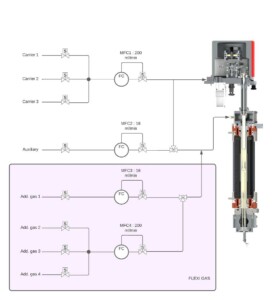
To replicate the actual conditions of many industrial processes or study the reaction mechanisms of materials, THEMYS allows researchers to work under a wide variety of precisely controlled gas atmospheres.
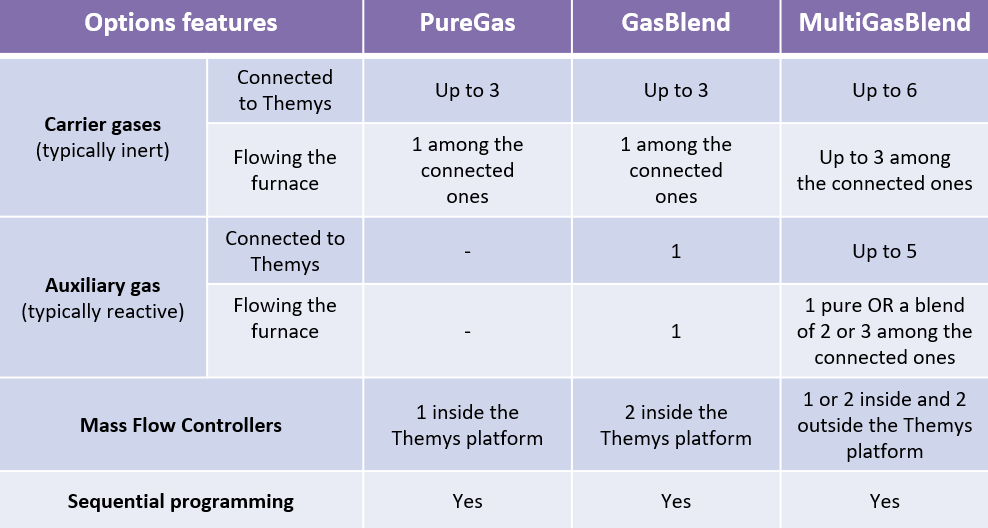
Depending on the selected configuration (PureGas, GasBlend, or MultiGasBlend), several inert gases such as nitrogen, argon, or helium can be used alone or mixed with reactive gases (oxidizing or reducing, but non-corrosive).
Flow rates, gas compositions, and atmosphere changes are fully controlled by software and can be programmed before the analysis and modified during it. This flexibility allows for the precise reproduction of operating conditions encountered in real-world applications.
Application notes
Thermogravimetric analysis under vaccum
Some applications require operation under reduced pressure in order to replicate industrial process conditions, remove residual gases from the analysis chamber, or perform degassing operations prior to introducing a reactive gas.
To meet these needs, THEMYS offers several vacuum levels tailored to different experimental requirements.
A first configuration allows for a primary vacuum of up to 1 mbar.
For applications requiring a higher vacuum level, a kit that includes a vacuum gauge enables a vacuum of 10⁻² mbar.
Finally, a configuration equipped with a turbomolecular pump allows for analyses under a secondary vacuum of up to 10⁻⁵ mbar.
These various solutions provide conditions perfectly suited for studies of outgassing, thermal decomposition, or reactions sensitive to the presence of residual gases.
Application notes
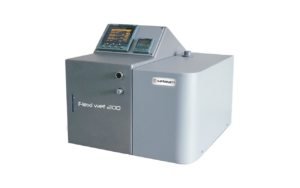
Thermogravimetric analysis under a humid gas atmosphere
Application notes
Thermogravimetric analysis under hydrogen
For applications in the energy, metallurgy, or reduction processes sectors, THEMYS H2 is a version specifically designed to operate with hydrogen concentrations of up to 100% H₂.
Unlike solutions that require mixing with a diluent or shielding gas, hydrogen is fed directly into the main gas circuit to ensure a precisely defined atmosphere around the sample.
Dedicated safety features prevent any accidental formation of an air-hydrogen mixture inside the furnace and allow for safe analysis up to 1,750 °C.
This configuration paves the way for studying materials under conditions representative of reduction processes, hydrogen production, or technologies related to the energy transition.
Thermogravimetric analysis under corrosive gas
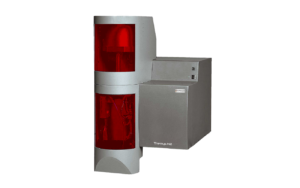
For the study of materials in chemically aggressive environments, THEMYS can be equipped with configurations specifically designed for use with corrosive gases.
Protection of the analysis chamber with a silica tube, combined with protection of the microbalance using an inert gas, makes it possible to perform thermogravimetric measurements under pure corrosive gases.
This design ensures the protection of the instrument’s sensitive components while faithfully reproducing conditions similar to those found in real industrial environments.
Depending on the gas used and the selected configuration, analyses can be performed up to 1,000 °C under corrosive gases and up to 1,750 °C under certain particularly demanding reactive gases.