Why choose a DTA tri-couple rod to analyze material behavior at high temperatures?
The DTA tri-couple rod developed by Setaram offers unmatched sensitivity for detecting even the most subtle thermal phenomena, even at extreme temperatures. Thanks to its unique design, it can reveal phase transitions or thermal effects that conventional DTA sensors cannot detect.
Detection of phase transitions: why high-sensitivity thermal analysis is essential
Metal alloys, ceramics, and many engineering materials undergo phase transitions at different temperatures.
To ensure their stability and performance at high temperatures, it is essential to accurately detect these transitions, including the most subtle ones, particularly when the materials are intended for demanding applications or complex heat treatments.
However, certain thermal phenomena are extremely subtle and go undetected by standard DTA detectors. A more sensitive sensor is therefore essential for properly characterizing these materials.
THEMYS Tri-couple DTA Sensors: The Most Sensitive Solution for Differential Thermal Analysis
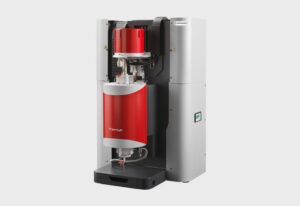
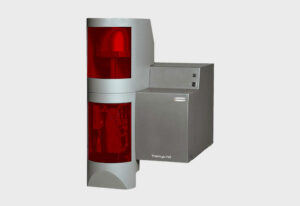
The THEMYS thermal analyzer is renowned for its versatility. Thanks to its interchangeable modules, it supports a wide range of techniques, including thermogravimetric analysis (TGA), differential thermal analysis (DTA), differential scanning calorimetry (DSC), simultaneous thermal analysis (STA) that is, simultaneous TG-DSC or TG-DTA, gas evolution analysis (EGA), and thermomechanical analysis (TMA).
When it comes specifically to differential thermal analysis (DTA), various DTA sensor models are available. Among them, triple-couple DTA sensors stand out for their high sensitivity.
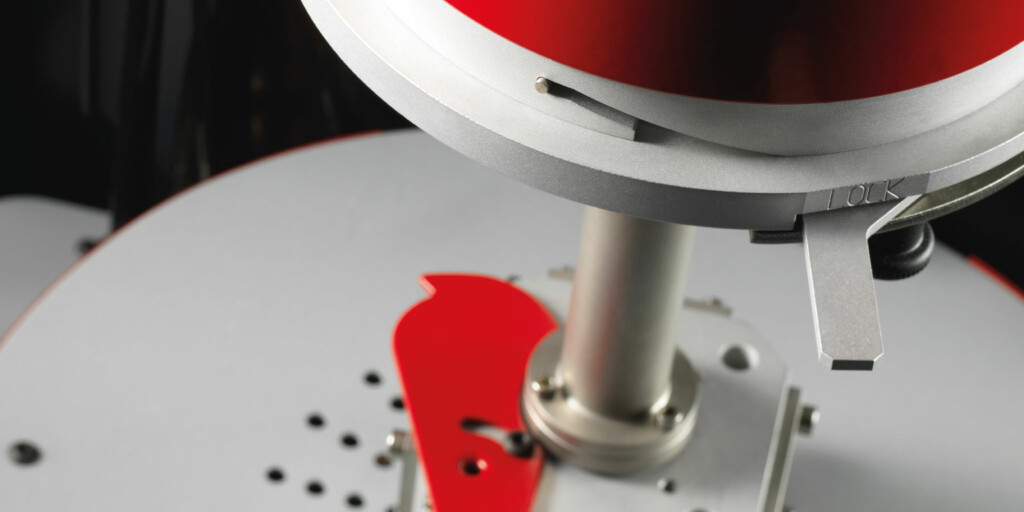
Unlike conventional sensors equipped with a single thermocouple under each crucible (measurement and reference), triple-couple rods incorporate three thermocouples connected in series, resulting in an amplification of the measured temperature difference signal. Consequently, triple-couple DTA rods offer higher sensitivity than single-couple rods.
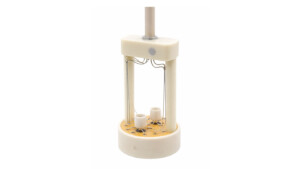
Benefits of DTA triple-couple rods: enhanced sensitivity for high-temperature material analysis
Thanks to their high sensitivity, DTA tri-couple rods are used to:
- detect extremely weak thermal effects that are imperceptible with conventional singlecouple sensors;
- better separate and analyze complex thermal signals, which, when measured with singlecouple rods, would be too weak to be reliably analyzed.
This provides our users with a better overview of all phase transitions in their samples, including in the case of multicomponent materials or phenomena occurring at high temperatures.
This allows them to gain a deeper understanding of the thermal behavior of their materials.
Zircon: How the DTA triple-couple rod improves detection of the monoclinic–tetragonal transition
Example: Solid-solid phase transition of zirconia
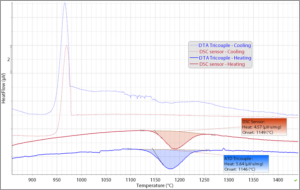
Measuring the monoclinic-to-tetragonal phase transition of zirconia around 1,200 °C perfectly illustrates the sensitivity performance of DTA tri-couple sensors.
During heating, an endothermic effect appears between 1,125 °C and 1,225 °C. This was measured using two sensors (DTA tri-couple and standard DSC).
Although it is observed with both the DTA tri-couple sensor and the DSC sensor, the sensitivity is 23% higher with the DTA tri-couple. Consequently, the design of this sensor offers a more precise measurement of high-temperature thermal phenomena, not only compared to conventional DTA sensors but also compared to DSC sensors.