
Why is the hang-down balance superior to horizontal and top-loading designs for TGA?
In thermogravimetric analysis (TGA), buoyancy effects caused by gas density changes can distort mass measurements, especially at high temperature.
The hang-down balance minimizes these effects at the source, delivering more reliable data than horizontal or top-loading designs.
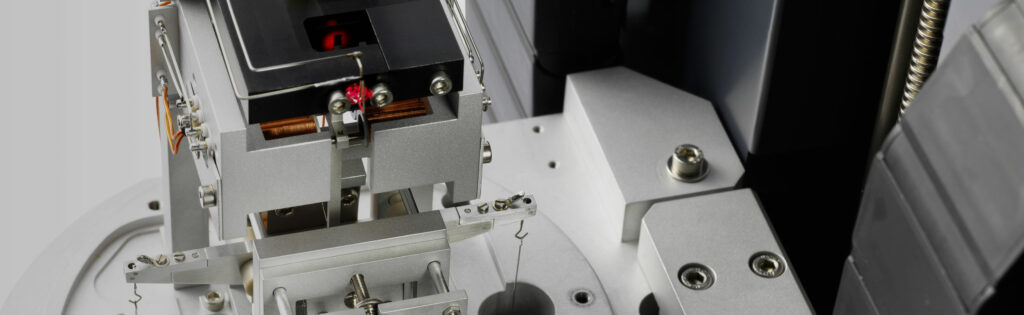
Buoyancy: a critical source of error in TGA
Buoyancy is a physical effect that modifies the apparent mass measured during a TGA experiment.
As temperature increases, changes in gas density generate an additional force on the sample holder, which directly impacts the recorded signal.
To obtain correct mass loss data, this buoyancy contribution must be measured separately and subtracted using a blank run.
Why hang-down balances reduce buoyancy effects ?
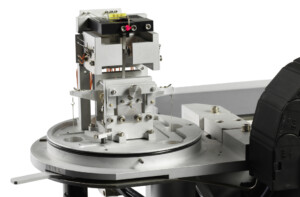
In a hang-down thermobalance, the sample is suspended using fine suspension wires rather than a massive measuring rod.
This design significantly reduces the volume exposed to the surrounding gas, thereby limiting buoyancy forces acting on the system.
Compared with horizontal or top-loading configurations, the hang-down balance intrinsically minimizes buoyancy contribution before any correction is applied.
Lower correction, lower uncertainty
Because the buoyancy contribution is already reduced, the value that must be subtracted during blank correction is much smaller.
Subtracting a small value inherently generates less measurement uncertainty than correcting a large buoyancy signal.
The result is more accurate, more reproducible TGA measurements, particularly critical for high-temperature and low-mass-loss applications.
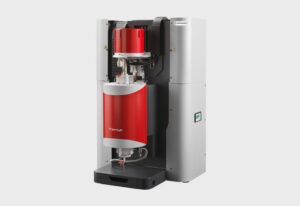
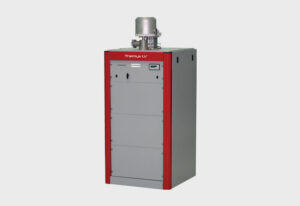
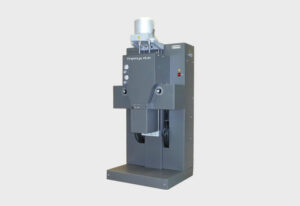
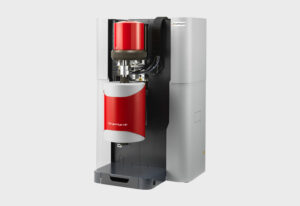
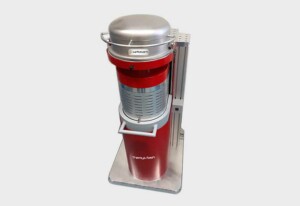
Versatile Setaram TGA instruments equipped with a hang-down balance :
Setaram has chosen the hang-down balance design across several high-performance thermal analyzers.
Frequently asked questions
Why is buoyancy more problematic at high temperature?
Gas density decreases as temperature increases, so high-temperature experiments increase buoyancy forces variation and their impact on mass measurements.
Is a blank correction still required with a hang-down balance?
Yes, systematic blank correction is always part of best practices for obtaining the best measurement results, but the correction value is smaller, which improves overall data reliability.
For which applications is a hang-down thermobalance recommended?
It is particularly well suited for high-temperature studies, low mass-loss measurements, and applications requiring high precision.
Want to go even deeper?
Read our technical documents on hang-down balances
Request more information
If you would like more information about our solutions and techniques or to discuss your application, please contact our experts.