High-Temperature Calvet Sensors: Accurate Thermodynamic Measurements Up to 1600°C
Date: - Categories: Product & Brand
If you’re benchmarking calorimetry and DSC instruments, you’ll quickly realize that:
- Most available sensors reach their limits in the 600 to 1000°C range, right where numerous critical thermal phenomena in materials science begin to occur.
- The few sensors that reach these temperatures, or even higher ones, cannot accommodate larger sample holders to compensate for the inevitable temperature-related decrease in sensitivity.
Studies on ceramics or metallic alloys phase transitions, molten salts behavior, high-temperature material stability or heat capacity all demand measurement capabilities that go far beyond standard flat shaped DSC sensors.
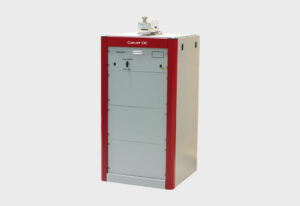
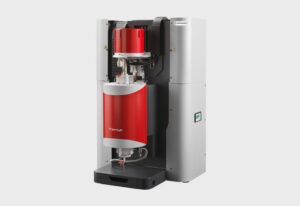
The high-temperature Calvet sensor technology, originally available on the Calvet DC and adapted to Themys and Themys ONE was developed to answer exactly this need: combining extreme temperature range and larger sample capacity, without compromising on measurement accuracy and precision
High-Temperature Calorimetry: Thermodynamic Measurements Up to 1600°C
Many critical applications require thermodynamic characterization at temperatures conventional calorimeters simply cannot reach.
The high temperature Calvet sensor extends thermodynamic measurement capability up to 1600°C, opening access to thermal phenomena that remain completely invisible to standard calorimetric instruments.
This temperature range is particularly critical for researchers and engineers working on high-temperature ceramics, and any material whose processing or operating conditions exceed conventional analytical limits.
High-Sensitivity Calorimetry: 20 Thermocouples for Superior Thermal Detection
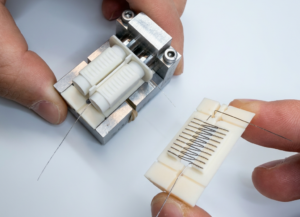
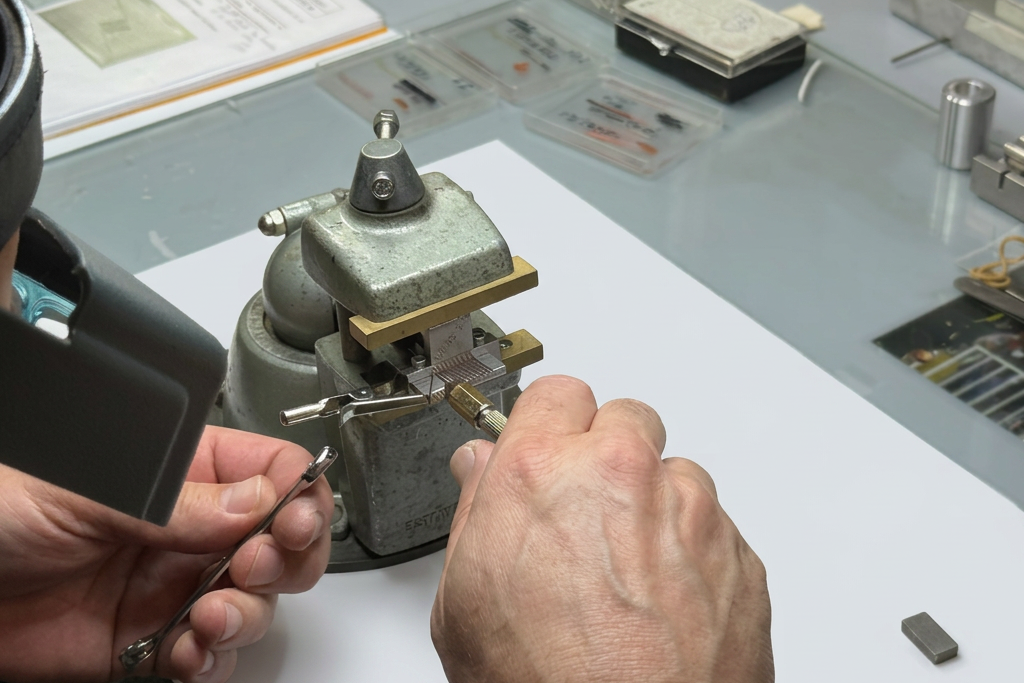
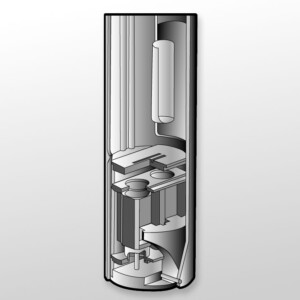
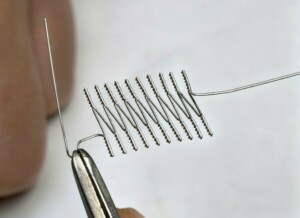
Standard calorimetric sensors typically rely on a single thermocouple architecture to detect heat flow. The Calvet sensor takes a different approach: it is built with 20 thermocouples placed between a reference zone and a sample zone, amplifying the thermal signal far beyond what conventional sensors can achieve. This architecture is calibrated by the melting of standard reference materials, ensuring accurate and traceable measurements.
The result is a level of accuracy that standard sensors cannot match, making Calvet sensors particularly useful for characterizing thermal effects with minimal uncertainty. In high-temperature applications, this added accuracy can be the deciding factor between an inconclusive measurement and a fully characterized phenomenon.
Larger Sample Capacity for More Representative Thermal Analysis Results
Beyond temperature range and sensitivity, the Calvet sensor also accommodates larger sample sizes than conventional DSC technology.
This is a significant advantage when working with heterogeneous materials, multi-component systems, or samples where a small aliquot may not be representative of the bulk material’s real thermal behavior.
Larger sample volumes mean more representative data, particularly valuable for industrial materials such as molten salts, ceramics, or composites where homogeneity cannot always be guaranteed at small scale.